
Fire doors being fit for purpose can be the difference between life and death in a fire outbreak.
In this article, we will take a look into what landlords look into when looking for new fire doors and how to effectively maintain them afterwards.

PROTECT YOUR people
The purpose
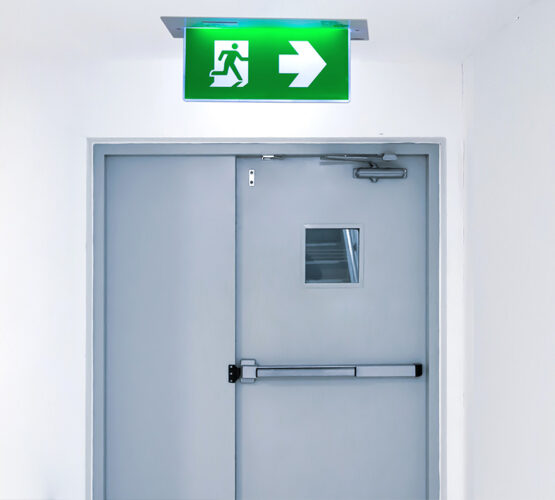
As one of the most effective forms of passive fire protection, a fire door’s job is to prevent and delay the spread of fire to other parts of a building. This gives people in the building the needed time to escape and evacuate the building and fire services time to start tackling the fire.
A fire door is a specialised product that is more complex than a standard door. They contain many layers of fire-resistant material such as the leaf, frame, seal and glazing, which all act as protective barriers to stop the spread of fire and save lives.
protect your residents
How to select a fire door
The national building regulations details the performance requirements of a fire door. Schedule 1 of the Building Regulations that apply to England and Wales and is split into parts, with the second part B detailing fire safety. Each has approved documentation on how to meet the safety requirements. Read on to find out how you can be sure that the fire door you are purchasing meets building regulations.
Every fire door is required to have the needed proof of performance for the ratings they are accredited. This is achieved by testing to BS 476 Part 22 or to the European equivalent BS EN 1634 Part 1. Doors are tested as a complete product, and can only be accurately tested with compatible components such as frames, ironmongery and seals.

With long-standing third-party certification of fire doors and selecting a fire door that has been fully tested, landlords can be confident that their fire doors will perform as described in the event of a fire. With the addition of competent installation and regular maintenance, residents or occupants can be reassured that they are fully protected.
When a door has third-party certification, it means that the fire door manufacturer has been inspected and the product is tested appropriately to ensure that the product is produced to a consistent high standard. For an example of manufacturing standards, the BWF fire door alliance requires hitting a series of requirements.
These results are displayed on a label on top of each door for transparency and reassurance to the customer that the product is certified. This also gives an ID number that includes certifications and production records.
keep your people safe
Maintenance and Inspections
While it’s important to ensure that a fire door is up to standards when publishing, performing regular inspection guarantees that the door remains safe. Using the 5-step check from the Fire Door Safety Week ensures that the door is in working order.
The five-step check:
You can read more about the five-step check in greater detail with our Fire Door Safety Week 5 Step Door Check Guide. Following a fire door check, it is of vital importance that you report any issues to the building owner to ensure that they are fixed. This is where the original certificate comes into use because the door is importantly maintained to the same level of quality as it originally was to maintain the third-party certification.
Fire safety bodies such as The Housing Act or the Fire Safety Order have powers of enforcement relating to fire doors and will need compliance with fire safety legislation. This can be done through the third-party certification that clearly states that the installed product meets the standards and the product performs as stated in the certification. These specifications should be adhered to prevent issues from arising relating to the safety of the fire door.
Fire doors should be regularly inspected to ensure they meet specifications. Both Landlords and residents can be reassured that the property remains safe from the threat of fire.
Website Design & Digital Marketing by Vector7 Ltd