
A beginner’s guide to fire doors

Fire doors are specifically made and tested to withstand fires for as long as possible.

Fire doors save lives and section the building to delay the fire spreading across the building. Using a few safety features built into the door, they can be of vital importance and mean the difference between life and death.

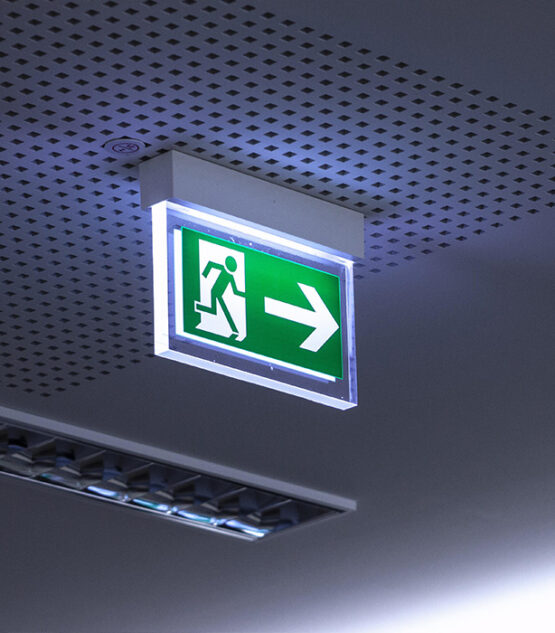
75% of fire doors in the UK are judged as unfit for purpose

Fire doors can mean the difference between life and death.

Fire Door Installation

PROTECT YOUR PROPERTY.

"Safeguard your people while creating a physical barrier to protect your property."

Most fire doors have two main functions: To provide a means of escape when open and to form a fire-resistant barrier when closed.

When close, they help to stop the spread of fire

When open, they provide a means of escape

It is because of this high importance for managing the

threat of fire that it’s important that all fire protection systems are inspected regularly, including fire doors. The new fire safety bill instructs companies to inspect these specialist doors on a quarterly basis. However, the Fire Door Inspection Scheme (FDIS) reports that 75% of fire doors in the UK are judged as unfit for purpose.

prevent the spread of fire.

"You must follow strict regulations to ensure that your doors meet certain criteria."

If you are the owner of non-domestic premises such as a

business or commercial property, you must follow struct regulations to ensure that your doors meet certain criteria, such as withstanding a certain heat. Also, these specialist doors should be installed by a competent installer as they are a carefully engineered safety device.

Landlords have a responsibility to ensure the property and its tenants are safe

The person responsible for the property and its safety has a legal responsibility under the FSO

Under the Regulatory Reform (Fire Safety) Order 2005 (FSO), landlords have a responsibility to ensure the property and its tenants are safe. The person responsible for the property and its safety has a legal responsibility under the FSO and can potentially be criminally prosecuted if they don’t fulfil these duties. This also includes the responsibility to conduct fire risk assessments in these non-domestic buildings.
Fire Door Installation

protect your people and assets

The features of fire doors

Here is a list of the key features of fire doors to be aware of for both commercial and domestic use.

Materials

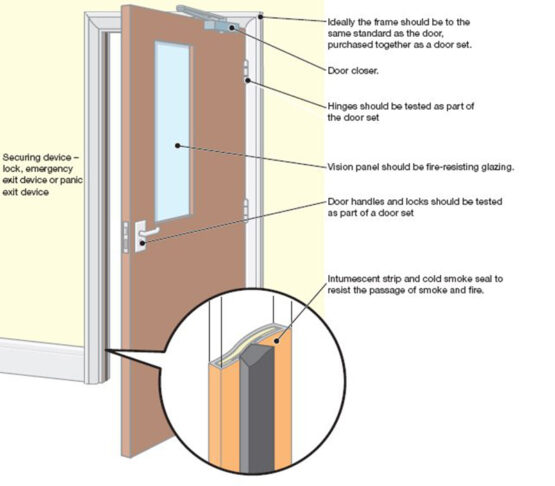
Firstly, fire doors are made of various materials specifically chosen to prevent the spread of fire. The door is usually made of a solid timber frame, though can also be covered in a layer of fire-resistant glass to further improve fire resistance. This glass should be able to withstand exposure to fire for a minimum of 60 minutes during testing.

Seal

The seal around the edges of a fire door is designed to expand when heated past 200°C. This fills the gaps between the door and the frame, creating a fire-resistant barrier.

Location

The location of fire doors within your property is important for resisting fires. For example, higher risk areas such as kitchens and rooms with electrical appliances should be prioritised. Furthermore, new builds should be subject to meeting fire door safety regulations by ensuring certain doors are fire doors. As it currently stands, fire doors are only legally required in Houses in Multiple Occupation (HMOs).

Risk assessments

A risk assessment must be carried out to determine fire doors, escape routes, lighting / warnings, equipment checks and other passive fire protection measures. It is advisable to get professional help with all fire-safety regulations and risk assessments.

Door specification

Choosing a door is important as knowing which door can tell you the extent of its fire resistance. Doors have an FD code that shows how many minutes a fire door can withstand before softening. For example, an FD30 door is rated to withstand 30 minutes of fire. FD30 and FD60 doors are the most commonly used. The test procedures manufacturers use are specified in BS 476-22:1987 or BS EN 1634-1:2014.

Smoke protection

Deaths caused by fire are usually not from direct contact with flames, but from inhaling the smoke. Most fire doors should be chosen with this in mind. A door with cold smoke seals prevent smoke from passing through the door. However, certain doors may be designed to leak smoke out of a building for the purposes of clearing the air and detecting fires earlier.

Website Design & Digital Marketing by Vector7 Ltd

×
×

Basket